


It is a mild spring day just outside London, yet the atmosphere inside Leavesden Studios feels anything but calm. On paper, it is a working film backlot. In reality, it resembles the final remains of a forgotten civilization. Crumbling architecture, shattered stone pathways, and the echoes of a once-great city surround the small group of journalists being guided through the set. What is being constructed here is not just a superhero film, but a world suspended between memory and collapse.
This is Krypton in its final days, reimagined for the upcoming Supergirl film directed by Craig Gillespie. The experience is immersive to the point of disorientation. One moment, the environment feels like ancient Rome reinterpreted through science fiction; the next, it resembles a disaster site slowly being reclaimed by dust and silence. The illusion is so complete that it becomes easy to forget this is a controlled set, carefully built for camera angles and continuity.
At the heart of this scene is a funeral procession. A young Kara Zor-El, portrayed during her teenage years by Milly Alcock, stands among figures dressed in ceremonial garments, including what appear to be Kryptonian religious attendants. A coffin rests solemnly at the center of the gathering. Nearby stands her father, played by David Krumholtz, his presence heavy with grief. The moment captures the emotional foundation of the film: loss, displacement, and the collapse of an entire world.
Yet filmmaking is never static. After a brief silence, the director calls for a reset. The mournful procession dissolves into technical activity. Crew members adjust lighting, reposition props, and restore continuity. What felt like the end of a civilization is revealed again as a carefully constructed illusion. This constant oscillation between emotional realism and production mechanics defines the entire visit.
The Last City of Krypton and the Weight of Memory
The depiction of Argo City, one of Krypton’s final surviving settlements, is central to the film’s visual and emotional identity. Depending on the scene being filmed, the city shifts between pristine and decayed. In one version, its waters are clean and luminous, evoking a fragile utopia. In another, they are darkened and corrupted, reflecting the inevitability of collapse.
Production design plays a crucial role in shaping this duality. The environment is not simply a backdrop but a narrative device. Every column, every fragment of stone, and every reflective surface contributes to the sense that Krypton exists both as a memory and as a warning. The creative team leans heavily into this instability, using physical set changes to mirror Kara’s shifting emotional state.
The production is also nearing its final phase. With only a few days left in the main shoot, the crew prepares to move to additional locations in Scotland and Iceland. There is a sense of transition not only within the story but within the production itself. The cast and crew describe the experience as resembling the final days of school, where routine continues even as endings approach.
Kara Zor-El: A Hero Defined by Absence
What distinguishes this version of Supergirl from previous interpretations is its emotional framing. Kara is not introduced as a symbol of hope or optimism, but as someone shaped by absence. Unlike Superman, who grew up detached from Krypton’s destruction, she carries direct memory of it. That distinction defines her entire psychological landscape.
Early footage shown during the set visit reinforces this tone. Scenes of Kara awakening on Earth, disoriented and emotionally detached, are intercut with moments of isolation and internal conflict. Even sequences that might traditionally be framed as humorous or adventurous carry an underlying sense of melancholy.
The film draws inspiration from darker, more introspective comic material, particularly narratives that emphasize survival rather than heroism. Kara is portrayed as someone who moves through the universe not with purpose, but with distance. Her interactions with Earth and other worlds are shaped by the fact that she does not fully belong anywhere.
This interpretation reframes her identity. Rather than a traditional origin story, the film becomes a study in emotional aftermath.
A Journey Across Broken Worlds
Beyond Krypton, the narrative expands into a series of fragmented environments scattered across space. Kara’s journey takes her through remote settlements, spaceports, and unstable colonies, each reflecting different aspects of decay and adaptation.

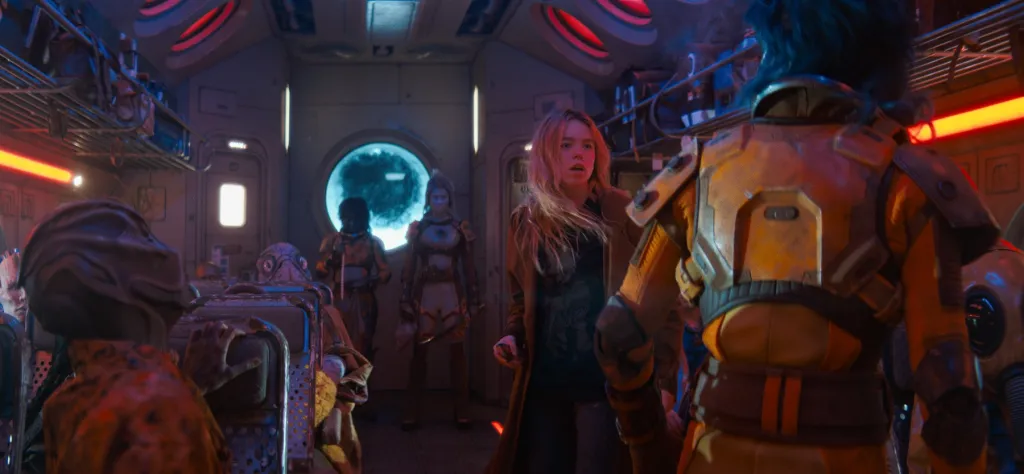
One of the most unusual elements described during the set visit involves a surreal intergalactic rest stop. Designed with practical effects, it includes bizarre alien lifeforms and surreal biological details that blur the line between humor and unease. These moments provide contrast to the film’s more somber core, introducing tonal variation without undermining its emotional foundation.
The production design of these worlds leans heavily into physical craftsmanship. Sets are built with tactile detail, emphasizing texture and materiality. Even the most fantastical elements are grounded in physical presence, reinforcing the idea that this universe, however strange, is tangible.
One of Kara’s companions on this journey is Ruthye Marye Knoll, a young character driven by personal tragedy and a desire for justice. Their dynamic introduces a secondary emotional axis to the story. Where Kara embodies loss on a cosmic scale, Ruthye represents loss on a personal and immediate level. Together, they form a fragile partnership shaped by grief and necessity.
Conflict, Pursuit, and the Shadow of Violence
The narrative also introduces antagonistic forces that further complicate Kara’s journey. Among them is Krem of the Yellow Hills, a figure responsible for devastating Ruthye’s family. His presence transforms the story into a pursuit across unstable territories, blending elements of revenge narrative with space-faring adventure.
The environments associated with Krem and his followers are visually distinct, characterized by harsher, more militarized aesthetics. Their world contrasts sharply with the organic decay of Krypton or the improvised fragility of civilian settlements. This visual separation reinforces the ideological divisions at the heart of the story.
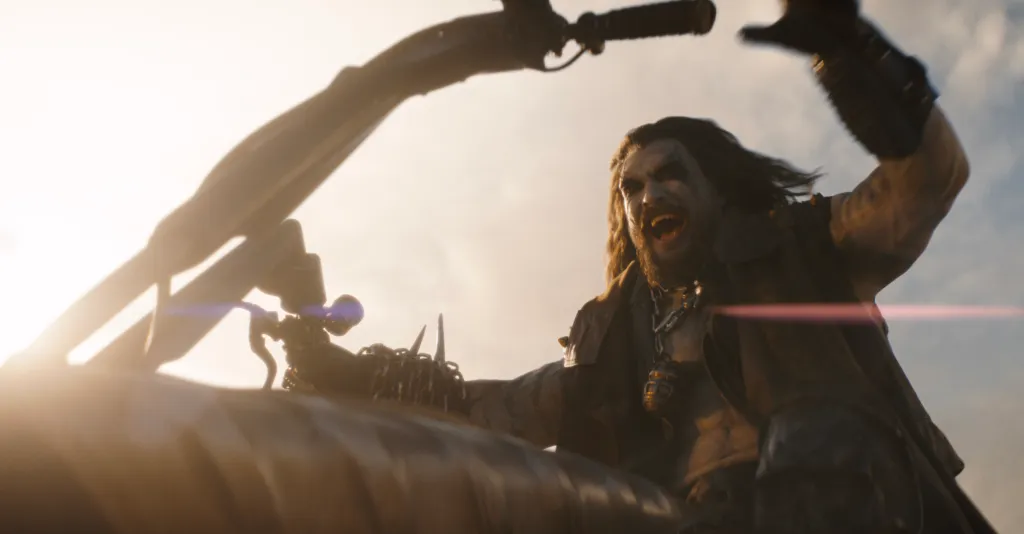
Another significant presence in the film is Lobo, a chaotic interstellar bounty hunter whose introduction adds unpredictability to the narrative. Rather than functioning as a traditional ally or antagonist, he occupies a shifting moral position. His involvement complicates existing motivations, introducing ambiguity into already unstable relationships.
Tone, Style, and Emotional Structure
Despite its heavy thematic foundation, the film is not entirely defined by darkness. The director’s previous work suggests an interest in balancing emotional intensity with moments of absurdity and levity. This duality is reflected in both set design and narrative pacing.
Certain sequences embrace surreal humor, often emerging from unexpected environmental details or alien interactions. These moments serve not to undermine the emotional weight of the story, but to prevent it from becoming monolithic. The universe of Supergirl is therefore constructed as emotionally varied rather than tonally uniform.
Music choices and visual references further reinforce this approach. Contemporary and alternative soundscapes are used to underscore Kara’s internal state, contrasting sharply with the classical associations of traditional superhero scoring. The result is a tonal identity that feels closer to psychological science fiction than conventional superhero storytelling.
A Hero Defined by Distance
At the center of the entire production remains Kara herself. Her costume, introduced later in the narrative, reflects a deliberate attempt to balance iconic design with emotional vulnerability. The physicality of the suit is intentionally less imposing than typical superhero armor, emphasizing movement and fragility rather than dominance.
This design philosophy mirrors the broader thematic direction of the film. Kara is not positioned as an untouchable symbol, but as a young woman still negotiating identity, trauma, and belonging. Even her connection to Earth is filtered through distance rather than integration.
The film ultimately avoids framing itself strictly as an origin story. Instead, it positions itself as a continuation of emotional consequence. Krypton is not merely a destroyed world in the past; it is an active presence shaping every decision, every interaction, and every moment of silence.
Conclusion: Between Ruin and Becoming
What emerges from this production is a story built on contrasts. Ruin and reconstruction. Memory and invention. Heroism and uncertainty. The world of Supergirl is not defined by clarity, but by fragmentation.
Walking through the sets at Leavesden, it becomes clear that the film is less interested in presenting a fixed mythology than in exploring what it means to live inside the aftermath of one. Krypton is gone, but it continues to exist in every shadow Kara carries with her.
In that sense, the film is not only about a heroine finding her place in the universe. It is about learning to exist when the place you came from no longer does.