

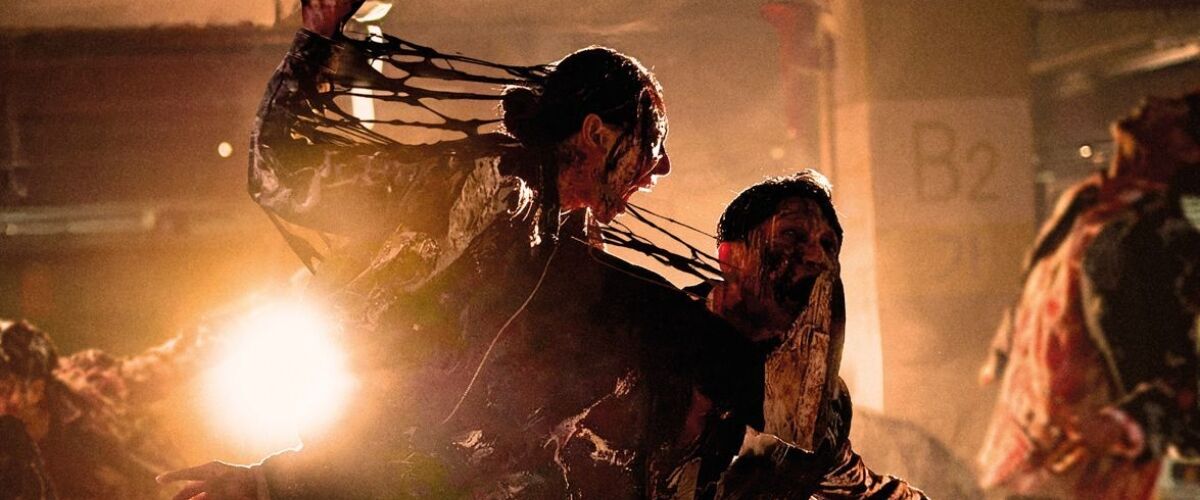
A decade after redefining modern zombie cinema with Train to Busan (2016), South Korean filmmaker Yeon Sang-ho returns to familiar territory in Colony, but this time he confines the apocalypse to a single towering structure. The result is a tightly contained, pressure-cooker survival horror film that trades sprawling outbreaks for claustrophobic escalation, turning an ordinary Seoul office block into a multi-layered death trap where escape feels perpetually close—but never guaranteed.
Rather than expanding the universe he previously built through Seoul Station and Peninsula, Yeon strips everything back. Colony is designed as a standalone outbreak story, unfolding over the course of a single day inside the Doongwoori Building. That choice immediately defines the film’s identity. This is not a story about the collapse of society at large, but about how quickly order disintegrates when movement is restricted, communication breaks down, and people are forced into vertical survival.
A Building That Becomes a Trap
The Doongwoori Building starts as an unremarkable corporate space, but Yeon’s direction transforms it into something far more sinister. Floors become territories, stairwells turn into choke points, and elevators feel like death traps waiting to happen. The film uses verticality as its primary source of tension, constantly reminding the viewer that safety is not a destination, but a shifting illusion just one level above—or below—where the characters currently are.
Cinematographer Byun Bong-sun captures this structure with clinical precision, allowing each environment to feel distinct without ever breaking the sense of confinement. Sleek commercial interiors, dim maintenance corridors, and overcrowded office spaces all carry their own rhythm of danger. The building itself becomes an active participant in the violence, shaping movement and dictating survival in ways that feel both natural and suffocating.
Early moments briefly suggest a more traditional containment scenario, with survivors attempting to regroup and understand the outbreak. But that stability collapses quickly. Once the infection spreads beyond control, the structure stops functioning as a workplace and becomes a layered hunting ground where the infected and the living are constantly collapsing into each other’s paths.
Infection Without Purpose, Survival Without Time
At the centre of the outbreak is Young-chul, a disgruntled former biotech employee played by Koo Kyo-hwan. His motivations are sketched in broad strokes—professional betrayal, stolen research, resentment—but Colony is not interested in psychological depth. The virus is already in motion, and explanation quickly becomes irrelevant compared to containment failure.
The infection itself follows familiar rules: bites spread rapidly, bodily fluids escalate danger, and desperation drives poor decisions. What sets Colony apart is how little time it allows for reflection. Characters are rarely given space to process events before the next collapse forces them into movement again.
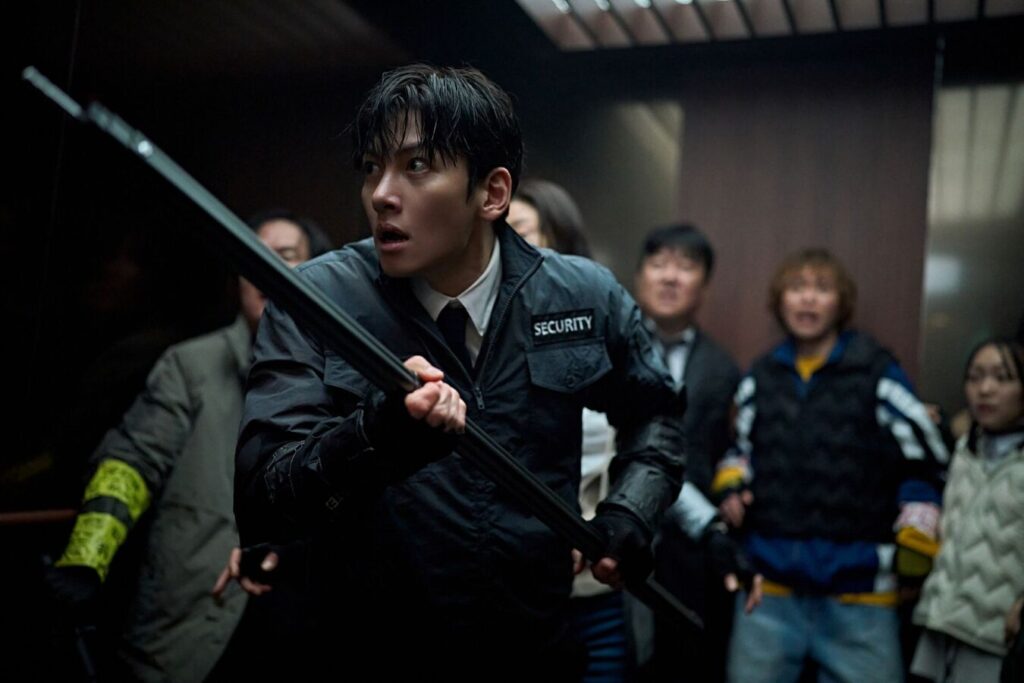
Among the survivors, a small group anchors the narrative. Professor Se-jeong provides fragmented clarity in moments of crisis, often forced into the role of translating chaos into instructions no one can fully follow. Hyun-seok, a security guard played by Ji Chang-wook, and his sister Hyun-hee, a wheelchair-using IT specialist portrayed by Kim Shin-rok, bring a grounded emotional thread to the otherwise relentless pacing. Their sibling dynamic becomes one of the few consistent emotional through-lines, offering brief pauses of humanity in a film that otherwise refuses to stop accelerating.
Zombies as an Evolving Collective
Where Colony most aggressively differentiates itself from standard genre fare is in its depiction of the infected. These are not static monsters. Early encounters show them as erratic, almost disoriented figures, stumbling through space with instinctive aggression rather than coordination. But that phase does not last.
As the infection spreads, the behaviour of the horde begins to shift in unsettling ways. Movement becomes more efficient, attacks more coordinated, and spatial awareness more collective. Yeon gradually introduces the idea of a shared intelligence, where one infected individual’s discovery is rapidly inherited by the entire group. A single breakthrough in movement or targeting instantly becomes communal knowledge, turning the swarm into something closer to a distributed organism than a crowd.
This escalation transforms the threat from physical danger into systemic inevitability. The survivors are no longer simply outrunning monsters—they are being out-evolved in real time.
The result is one of the film’s most effective ideas: the sense that adaptation itself is the true antagonist. Every moment of survival feels temporary, as if the rules of the game are quietly changing mid-chase.
Choreographed Chaos and Physical Horror
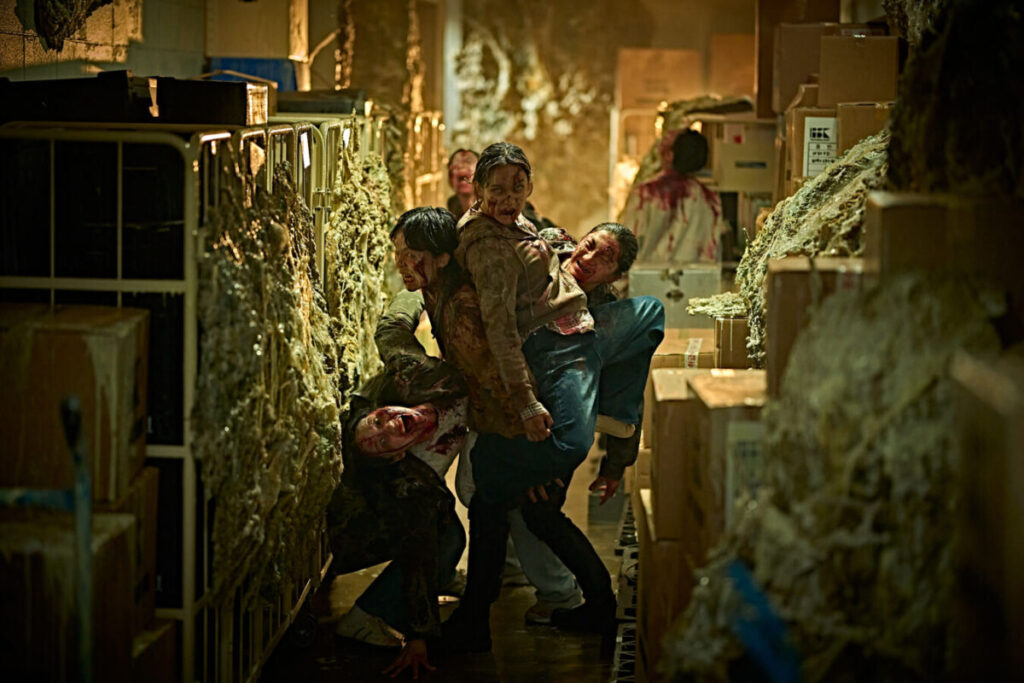
Yeon Sang-ho’s background in animation is visible in nearly every action sequence. Movement is rarely random. Even the most chaotic outbreaks feel carefully staged, with bodies flowing through space in patterns that resemble distorted choreography. The infected twist, collapse, and climb over one another with a disturbing physical logic that makes every encounter visually legible even at its most frenzied.
The performers playing the infected deserve particular recognition. Their commitment to physical distortion—bending joints, collapsing posture, and erratic synchronization—creates a visual identity that feels both grotesque and strangely rhythmic. Rather than relying heavily on digital augmentation, the film embraces practical performance, allowing the horror to remain tactile and grounded.
Violence in Colony is constant but rarely gratuitous. It is functional, almost industrial in its frequency. The film understands that in a confined space, escalation is inevitable, and it uses that inevitability to maintain pressure rather than shock value.
A Familiar Story Beneath the Surface
Narratively, Colony is intentionally minimal. Character arcs are functional rather than transformative, and dialogue often exists solely to move characters from one crisis to the next. Emotional beats are present, but they are quickly overtaken by urgency.
There are moments where the film gestures toward broader themes—corporate negligence, scientific ethics, institutional collapse—but these ideas remain underdeveloped. They exist more as context than commentary, quickly overshadowed by the immediate demands of survival.
A group of younger characters repeatedly reinforces the genre’s long-standing tradition of irrational decision-making under pressure, serving less as individuals and more as catalysts for new outbreaks of chaos. Their presence underscores the film’s core philosophy: intelligence offers little protection in a system designed to break down faster than people can adapt.

Conclusion: Controlled Panic at Maximum Intensity
Colony does not attempt to reinvent zombie cinema, but it refines a specific version of it. By locking its apocalypse inside a single building and letting escalation do the narrative heavy lifting, Yeon Sang-ho crafts a film that thrives on containment, repetition, and controlled intensity.
Its weaknesses lie in its simplicity. Characters are thinly sketched, motivations are quickly discarded, and thematic ambitions rarely extend beyond surface level. But those limitations feel intentional rather than accidental. This is a film built around momentum, not introspection.
What it delivers instead is sustained pressure: a rising sense that every floor is worse than the last, every moment of calm is temporary, and every attempt at escape only tightens the structure around its characters.
In the end, Colony succeeds not because it expands the zombie genre, but because it compresses it—until there is nowhere left to run except deeper into the building.