

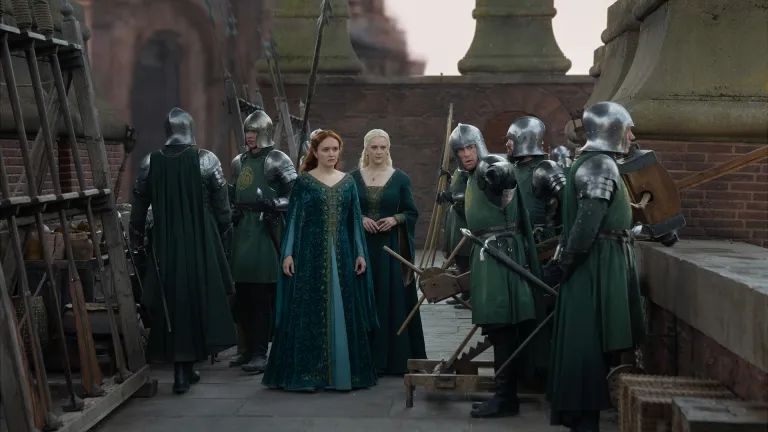
For longtime readers and viewers invested in the A Song of Ice and Fire universe, House of the Dragon has always carried a heavy burden: it is not just adapting source material, but extending a cultural mythology already defined by Game of Thrones and George R.R. Martin’s distinctive narrative voice. With season 3 episode 2, that tension becomes more visible than ever—not in the scale of its events, but in the texture of how those events are written and delivered.
Like many fans who have followed the franchise since its peak years, there is an increasing sense of distance from the series, even when the story itself remains structurally ambitious. It raises a central question that the episode unintentionally highlights: what happens when the world of Westeros continues, but its linguistic and tonal identity begins to shift?
The Weight of Language in Westeros
One of the most noticeable elements in this episode is not plot or spectacle, but dialogue. Across multiple scenes, characters speak in a manner that feels functional rather than poetic, direct rather than layered. The writing prioritizes clarity over rhythm, which on the surface is not a flaw—but in a universe historically defined by dense subtext and stylized language, it creates a perceptible tonal gap.
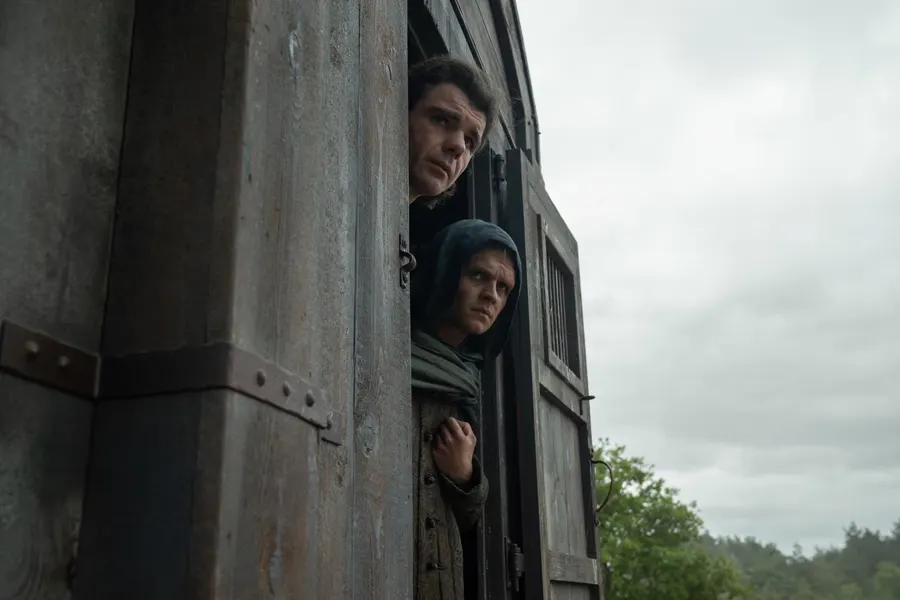
Lines delivered by central figures such as Daemon Targaryen, Rhaenyra, Larys Strong, and others are straightforward to the point of simplicity. Conversations often state intention rather than implying it, leaving little space for interpretation. Where earlier entries in the franchise often relied on insinuation, metaphor, or verbal wit, this episode frequently opts for direct exposition.
This shift matters because Game of Thrones established a standard where dialogue functioned not only as communication, but as character architecture. Even brief exchanges carried political weight, emotional ambiguity, or thematic resonance. In contrast, the writing in this episode often feels more utilitarian, serving the plot without fully enriching it.
When Dialogue Becomes Invisible Structure
The issue is not that the dialogue is fundamentally poor, but that it rarely rises above functional storytelling. In a grounded fantasy world that depends heavily on perceived realism, language plays a structural role. It shapes how audiences interpret power, tension, and emotional stakes.
When dialogue becomes too plain, something subtle begins to collapse. Scenes that should feel charged with political danger or personal grief instead take on a procedural quality. Characters move through events efficiently, but without the linguistic density that typically gives Westerosi storytelling its distinctive weight.
This becomes particularly noticeable in moments of high narrative importance, where major developments unfold with minimal verbal complexity. As a result, events that should feel monumental sometimes land with less emotional force than expected.
A Season Built on Major Movements
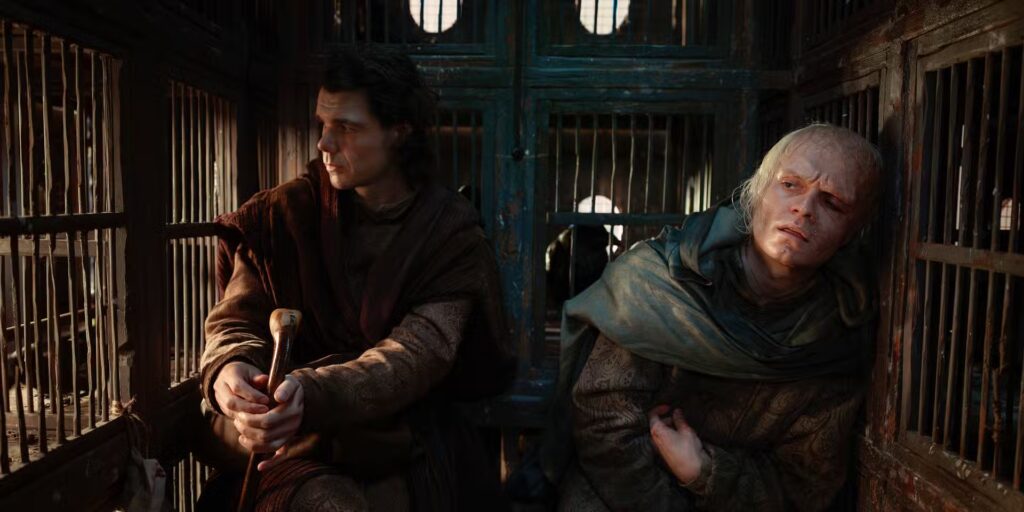
Despite these concerns, episode 2 is structurally significant. It contains several major turning points in the broader narrative arc. Key characters experience abrupt changes in fate, alliances shift, and power within King’s Landing undergoes a dramatic transformation.
Events involving Jace, Aemond, Otto Hightower, and Rhaenyra all carry substantial consequences for the unfolding civil war. Entire political structures are destabilized within a single hour of television, giving the episode the surface appearance of a season finale compressed into a mid-season installment.
Yet this rapid escalation also contributes to a sense of imbalance. The pacing accelerates so quickly that emotional processing struggles to keep up with narrative development. Moments that should feel like climactic payoffs instead arrive as near-instant transitions between plot points.
The result is an episode that is structurally dense but emotionally uneven.
Rhaena, the Vale, and the Problem of Directness
One of the episode’s key sequences involves Rhaena’s attempt to secure asylum in the Vale following recent catastrophic events. The scene is designed to carry emotional urgency, as her position is precarious and her actions are deeply tied to recent tragedy.
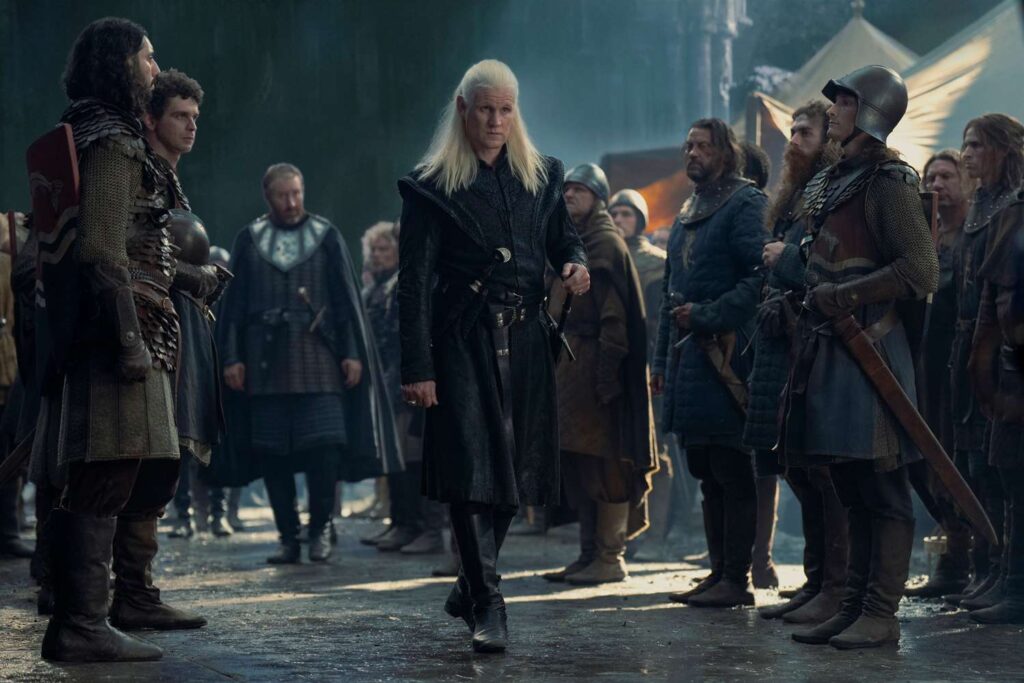
However, the execution emphasizes clarity over subtext. Dialogue between characters in this sequence often explicitly states motivations that could have been communicated more implicitly. The result is a scene that remains conceptually strong but lacks atmospheric tension.
Rather than allowing emotional pressure to build through silence, hesitation, or layered interaction, the scene frequently relies on direct verbal exchange. This reduces the sense of escalating danger and flattens what could have been one of the episode’s more psychologically charged moments.
Driftmark and the Weight of Exposition
A similar issue appears in the Driftmark storyline, where Baela, Alyn of Hull, and Corlys Velaryon are brought into a narrative thread that feels primarily designed to reposition characters rather than explore them.
While the performances remain solid and the setting visually compelling, the dialogue once again leans toward exposition. Characters articulate familial relationships and internal motivations in ways that feel explicitly explanatory, as though the audience is being guided through the narrative rather than allowed to infer it.
Corlys’ reappearance, while structurally necessary, further emphasizes how much of the episode is concerned with moving pieces into place for future conflict rather than fully inhabiting present emotional states.
Alicent Hightower and the Burden of Explanation
Perhaps the most striking example of this structural tendency appears in Alicent Hightower’s storyline. Throughout the episode, Alicent functions as a conduit for information transfer, moving between factions and attempting to communicate shifts in political reality to various groups within King’s Landing.
Her role becomes increasingly expository, tasked with articulating developments that other characters either cannot or will not acknowledge. This places her in a structurally difficult position: she is simultaneously participant and narrator of unfolding events.
The consequence is that her scenes often feel mechanically driven, as though she is delivering necessary updates rather than engaging in organically evolving interactions. Even moments that should carry emotional or political tension are frequently reduced to clear statements of intent.
This reinforces a broader pattern within the episode: characters increasingly function as vehicles for narrative information rather than fully reactive individuals within a lived environment.
The Invasion of King’s Landing: Scale Without Friction
The episode’s climactic sequence—the transition of power within King’s Landing—is visually and conceptually ambitious. Key figures move through the city with increasing control, culminating in a shift of authority that should feel seismic within the world of the series.
However, the execution again raises questions of friction. Opposition is minimal, resistance is fragmented, and key encounters often resolve without sustained conflict. The result is a sense of inevitability that reduces dramatic tension.
Even moments of confrontation are frequently staged in ways that prioritize clarity over chaos. Dialogue continues even in situations that might traditionally rely on silence, urgency, or physical expression. This contributes to an overall feeling that the episode is narrating its events rather than fully dramatizing them.
Moments of Performance That Break Through
Despite structural and tonal concerns, the episode is elevated at several key points by strong performances. Emma D’Arcy delivers one of the most emotionally resonant sequences in the episode, particularly in scenes involving grief and confrontation with loss. These moments succeed because they move beyond exposition into raw emotional expression.
Similarly, Aemond’s arrival in Harrenhal stands out as one of the most visually and tonally effective sequences. Here, direction, performance, and atmosphere align more closely with the darker, more mythic tone associated with the franchise at its best. The sense of fear and inevitability in these scenes restores some of the intensity that other portions of the episode lack.
These moments demonstrate that the underlying material still has strong potential when allowed to breathe and when performance is given space to carry emotional weight beyond dialogue.
Conclusion: A Strong Structure Strained by Language
House of the Dragon season 3 episode 2 is an episode defined by contradiction. On one hand, it advances the central narrative in significant and far-reaching ways, reshaping the political landscape of Westeros in a single hour. On the other hand, it struggles to consistently translate those developments into emotionally and linguistically compelling drama.
The core issue is not spectacle or ambition, but tone. When dialogue becomes overly direct, and when scenes prioritize clarity over subtext, the result is a gradual flattening of emotional depth. Even major events risk feeling procedural rather than transformative.
And yet, within that structure, there are still flashes of the richness that defines the franchise at its best—moments where performance, direction, and atmosphere align to briefly restore the sense of weight and myth that originally made this world compelling.
The episode ultimately stands as a reminder that in Westeros, power is not only fought over with swords and dragons, but also with words. And when those words lose their sharpness, even the strongest political upheaval can feel strangely muted.